UX Designer & Architect

Learning to live with PAH
The phaware global foundation created Walk Talk Track, a movement to capture health data from the Pulmonary Arterial Hypertension community to feed into the DYNAMITE clinical trial. The same foundation launched pHPAL , a patient app designed to help PAH patients manage an incurable, complex disease that affects their lungs, heart, and daily life. United Therapeutics, one of the world's leading rare disease pharma companies, adopted it as part of their PAH initiative.
However, people still weren't using it. The app had roughly 100 downloads, and patients were uninstalling it almost as fast as they installed it. During COVID when clinics disappeared overnight, disrupting typical PAH management protocol that depended on frequent, in-person specialist visit and lab imaging for medication adjustment. The PAH community needed this app to actually work more than ever.
I had 4 weeks to investigate and recommend UX strategy. I had to answer the big question:
Why did a clinically grounded, research-backed app was having a hard time retaining the very patients it was built for?

And with too many stakeholders, too little time, and too much ground to cover, I had to figure out what is most valuable to be delivered first? I planned a four-week North Star work. Where I repurposed Design Sprint for speed, Double Diamond for structure.
-
Week 1-2: I conducted research by doing Interviews, sentiment analysis, feature prioritization mapped against user and business needs simultaneously. At the end of week 2, I conducted an empathy workshop that helped product and engineering team understand the who and why.
-
Week 3-4: I lead a team of designers to generate any ideas, sketches and designs. End of week 4, we had key flows, we all got together to vote and workshop on what actually mattered.
-
Week 4 onwards: We did detailed design work to re-launch the app with new features.
Understanding the PAH patients
With assistance from phaware global foundation support, we recruited PAH patients ranging from age 7 to over 60, across every stage of diagnosis to interview.
PAH patients are not a typical patient group.
Everyday entails detailed planning. It starts from medications that are cannot be skipped. Timing is critical and often multiple drugs are administered simultaneously, some intravenously, some through inhalers.
Simple tasks take enormous energy and Functional assessments like 6-minute walk test (6MWT) helps them decide whether they can step out of the house for the day or not. For patients on oxygen, there's the practical reality of the tank further complicates their day with where it is, how full it is, how long they can be out with it.
COVID magnified all of this and compressed their small world even further.


In parallel, we also did analysis on app reviews, support tickets and stakeholder feedback sessions. When we asked them about the app, feedback was blunt. They installed the app hoping to be relieved of some of the "Covid" created pressure, instead it offered articles and tools that were "not easy to use".

Game, Gamification, or Gameful Learning? Which Way to Go?
PAH comes with an enormous information burden. New research. Medication updates. Clinical trial opportunities. Dietary guidelines. Exercise protocols. All of it written for clinicians, not patients. Caregivers, especially parents of children with PAH become self-taught medical translators. They read journals they weren't trained to read. They explain heart anatomy to a seven-year-old using metaphors they invented themselves. They do this while managing their own fear, their own exhaustion, their own grief.

To some of the stakeholders, the obvious fix was to make a game out of it. Others were drawing inspiration from language-learning apps like Duolingo or sporting app like Strava. Everyone was mixing up three genuinely different things: games, gamification, and gameful learning.
As a therapeutic healthcare app, making a game out of the learning content was out of question. So the choice was really between two. I ran a session to educate the room to take the final call
-
Gamification that borrows game mechanics to motivate through competition, escalation, pressure to do more.
-
Gameful learning borrows game mechanics to motivate through autonomy, mastery, and belonging — no one has to outdo anyone else to feel forward motion.

Gameful learning it is!
We picked few from the ten principles of gameful learning, the real work sat in five connected principles:
-
Clear Learning Goals were tied directly to onboarding that asked if the user if they were recently diagnosed or teaching their kids about PAH.
-
Bite-sized learning paths paired with skippable quiz worked best. Quizzing immediately or mandatorily after every learning, tested badly.
-
Support Competence was shaped keeping in mind the chronically exhausted PAH patient. No leaderboards — pitching one immunocompromised patient against another. No forced streaks.
-
Productive failure for us to adjust the difficulty level of content quietly.
-
Joining a community unlocked badges and not the other ay around.


Redesigning the rest of the app
I lead a team of designers who then handled aspect of brand, motion, and illustration.

We delivered a sample design system kit aligned to United Therapeutics brand (as they wanted to adopt it as part of their PAH initiative)

Onboarding to cater to different experiences to different people - care givers, patients and whether they are recently diagnosed or long-term patients.
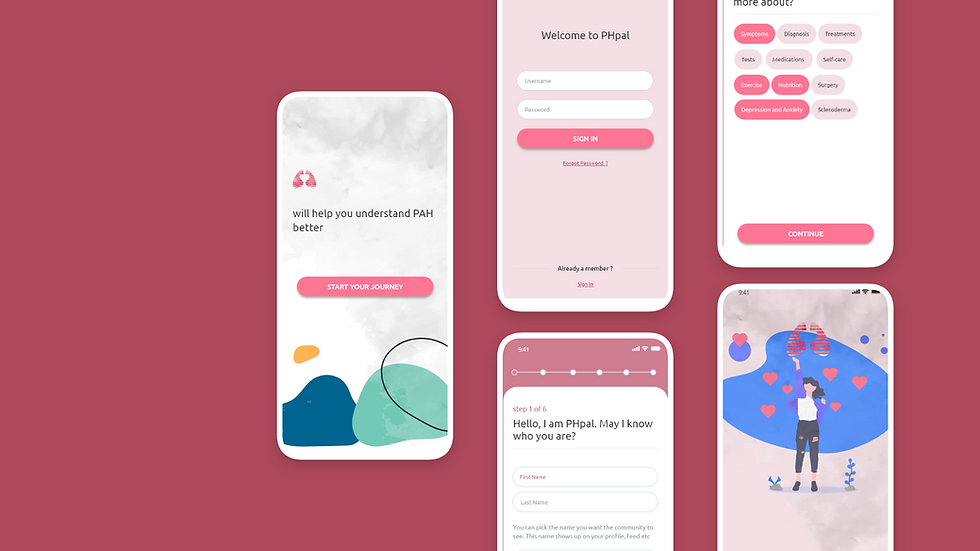
a home page that surfaces most important and personalised reminder to take meds, O2 stats, 6MWT, continue watching breathing videos, PAH news and updates

Track PAH that offers both trend reports and a sense making layer that helps them understand the good and the bad trends.

I could get a room full of stakeholders and teams to agree. But the harder job is knowing when to disagree with all of them.
Designing for immunocompromised patients meant that at every stage I had to be cognizant of their condition. Therefore I kept my stand against adding, leaderboard, mandatory quiz and streak reminders from our app. Most game-ful learning app have it as extrinsic motivation and stakeholders were asking for it too. I defended that call more than once. I'd make it again.
Soon after I completed this workshop, I left to join my next company. pH PAL doesn't exist anymore. The app was sunset, and I don't have a download curve or retention numbers to show for it.